Abstract
UC policy: UC campuses should move toward 100% zero emissions in general by 2045.
UCOP Sustainable Practices Policy: All new fleet vehicle purchases are expected to be
zero-emission by 2027.
How can UC San Diego improve reliability of its bus fleet and implement zero-emission buses while moving toward these UC policies?
Current Bus Fleet Information:
- Compressed Natural Gas (CNG) Shuttles: 24
- Electric Shuttles: 6
- 5–6 campus routes used every day
- About 500,000 student passengers quarterly
Goal: Clarify and present concrete problems that prevent UCSD’s bus fleet from becoming fully electric.
Materials & Methods
- Surveys from UCSD Transportation Services
- Interview with the General Manager of UCSD Transportation Services
- University of California Sustainability Report (2024)
- UC Irvine Anteater Express website and route maps
- California Air Resources Board (ICT / ZEB regulations)
- Triton Transit TransLoc app & route tracking
- Anteater Express live bus tracking map
- Policy document review and summary
- Descriptive statistics on fleet size and ridership
- Percentage comparisons against UCOP and CARB targets
- Visual comparison of shuttle routes (UCSD vs. UCI)
Background Statistics
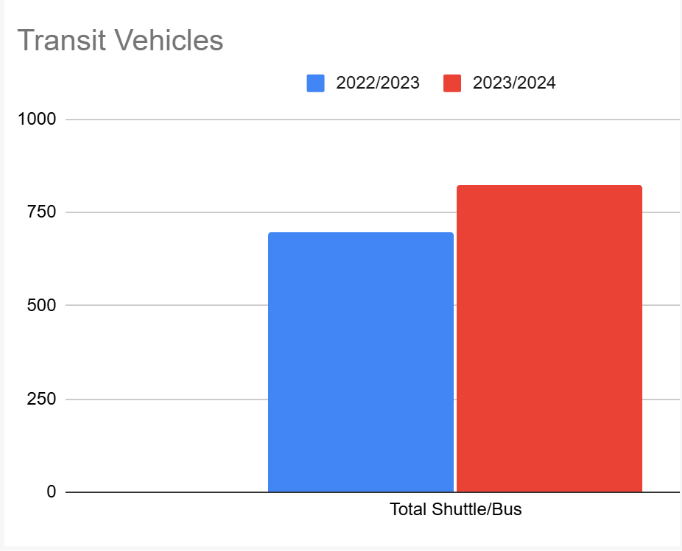
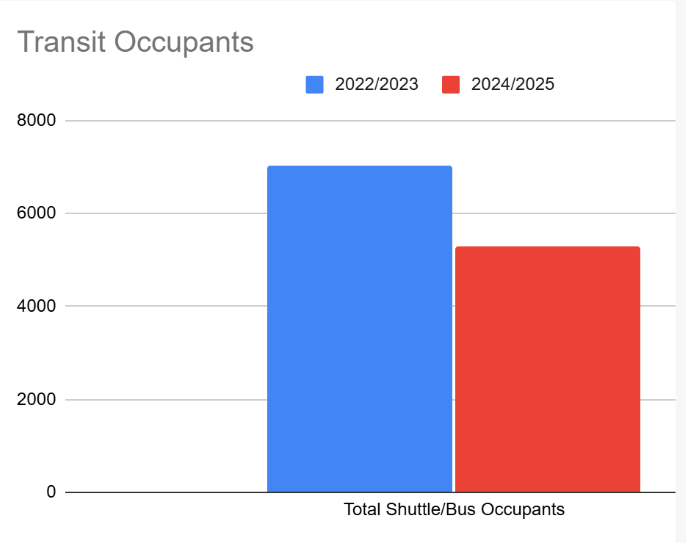
These charts show the differences between the amount of shuttles and buses that have been run for each year’s Winter quarter, as well as the number of people who have taken those shuttles and buses.
There is a notable decrease in the number of people taking public transit even though there is an increase in the number of shuttles and buses.
Current Bus Fleet Situation
6 out of 30 campus shuttles are electric.
- 6 electric / 30 total buses = 20% electrification.
- Compared to the UC system’s expectations for zero-emission fleets, UCSD is currently about 80 percentage points behind.
UC System Policy & Campus Comparison
| Feature | UC System Policy | University of California, Irvine (UCI) | University of California, San Diego (UCSD) |
|---|---|---|---|
| Target Year | 2045 | 2045 | 2045 |
| Ultimate Goal | 100% Zero Emissions | 100% Zero Emissions | 100% Zero Emissions |
| Current Zero-Emission Status (Transportation) | System-wide goal for all campuses | 100% achieved in student shuttle fleet | Approx. 20% electric (6 electric out of 30 shuttles) |
| Key Status / Method of Achievement | Mandated across all UC campuses by UCOP Sustainable Practices Policy | Achieved goal in 2017 by converting the student shuttle fleet to 100% Battery Electric Vehicles (BEVs). | 6 out of 30 shuttles are electric (20%). The remaining 24 shuttles run on CNG (Compressed Natural Gas), representing the remaining 80% gap. |
| Challenges for Achievement | - | None currently; focus is on maintenance and sustained operations of the existing electric fleet. | Phased or bulk replacement of the 24 CNG vehicles with electric or hydrogen models, and establishing sufficient charging infrastructure to cover the remaining 80% deficit. |
Comparing UCSD with UCI (Routes & Scale)
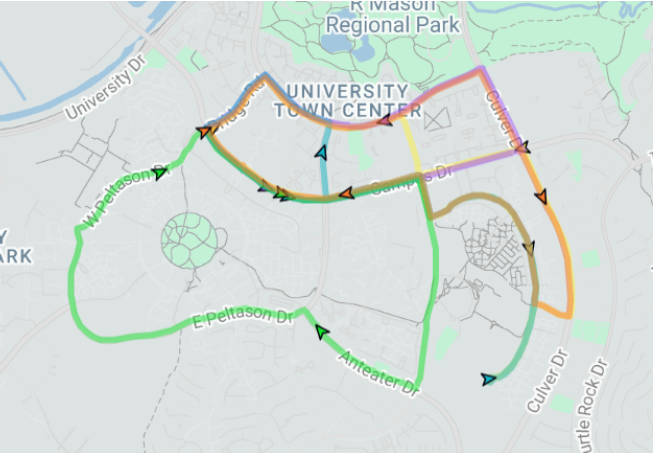
UCI (Anteater Express)
UCI runs a smaller, more compact shuttle network that mainly circles the campus and nearby housing. This simpler system made it easier for UCI to transition to a fully electric bus fleet.
UCSD (Triton Transit)
UCSD operates a larger and more complex network with long routes that connect main campus, medical centers, and surrounding areas. This scale increases operational challenges for electrification and reliability.
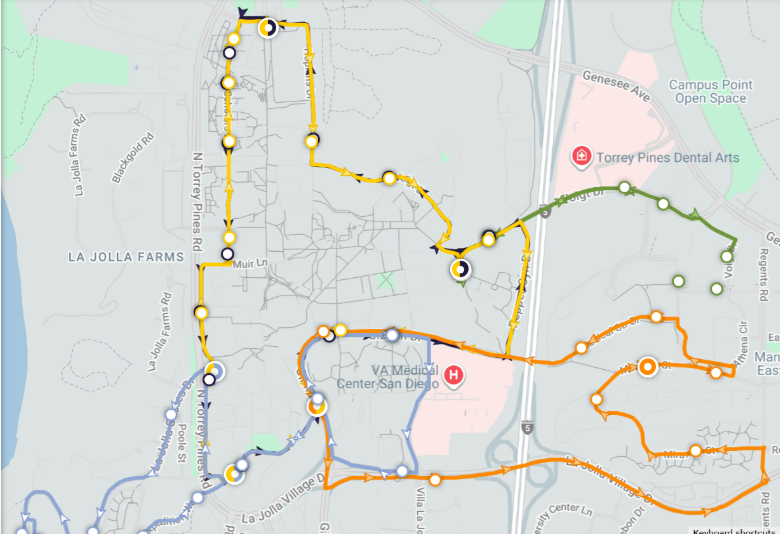
The main difference between the two systems is scale and route complexity. UCI’s compact system makes electrification easier, while UCSD’s large and branching routes require more vehicles, more charging capacity, and more carefully planned scheduling.
Data Highlights
- UCSD fleet: 24 CNG shuttles and 6 electric shuttles (20% electric).
- Ridership and total vehicles increased between 2022/2023 and 2024/2025, indicating higher demand and more pressure on the system.
- Rising demand plus slow electrification creates a risk of unreliable service and missed sustainability targets.
Interview Highlights (UCSD Transportation Services)
- Some electric buses stay parked because they are waiting on safety installs, repairs, or parts delays. They are rotated in as soon as they are service-ready.
- Charging mainly happens after 9 PM to avoid high daytime electricity costs. Daytime charging is possible, but not cost-efficient.
- New chargers at P705 will allow up to 12 buses to fast-charge overnight, reducing the current charging bottleneck.
- Tight turns (especially along Scholars Drive near Theatre District and Sixth College) are harder for electric buses because of their larger turning radius.
- Driver training improves as more electric buses become available—familiarity grows with regular rotation.
- Electric buses currently have more downtime than CNG units due to parts, technician availability, and cooling-system issues.
- UCSD’s goal is to reach 100% electric by 2040, with approximately 5–9 buses planned for replacement in the next two years.
Future Directions
This project highlights the specific challenges within UCSD’s on-campus shuttle fleet that currently prevent full electrification and alignment with UC systemwide sustainability policy. We hope that future teams will build upon these findings and develop actionable solutions.
Possible future directions include:
- New Fully Electric Shuttle Fleet — Evaluating procurement pathways and timelines to transition all campus routes to electric buses.
- Long-Term Funding for EV Infrastructure — Securing sustained investment for chargers, overnight capacity, and maintenance facilities.
- Route Optimization for Electric Buses — Adjusting campus route design to match battery range, charging schedules, and bus availability.
References
- Transportation Services, University of California San Diego. (2024). Transportation services survey data. UC San Diego. (Unpublished raw data).
- General Manager, UC San Diego Transportation Services. (2024). Personal interview [Interview].
- University of California, Office of the President. (2024). University of California sustainability report 2024. Retrieved from https://www.ucop.edu/sustainability
- University of California, Irvine. (n.d.). Anteater Express. Retrieved from https://www.shuttle.uci.edu/
- California Air Resources Board. (n.d.). Homepage. Retrieved from https://www2.arb.ca.gov/
- UC San Diego Triton Transit. (n.d.). TransLoc real-time map. Retrieved from https://ucsd.transloc.com/
- University of California, Irvine. (n.d.). Anteater Express bus tracking. Retrieved from https://uci.transloc.com/
Project Team
Team 5 – Manigbas, Leung, Harada, Cabebe
UC San Diego – SYN100 Student Research Project